His Girl Friday
A newsroom, a second chance, and a story too good to leave behind.
The Story
Hildy Johnson is a successful newspaper reporter who has decided to leave her demanding career behind. She plans to marry Bruce Baldwin, a quiet and respectable insurance salesman, and begin a more peaceful life.
But her former husband, Walter Burns, is also her editor, and he has no intention of losing his best journalist.
When an important criminal case attracts the attention of the press, Walter persuades Hildy to cover one final story. Soon, she finds herself investigating a possible injustice involving a condemned prisoner, dishonest politicians and a group of reporters who will do almost anything to get an exclusive story.
As events become increasingly complicated, Hildy must decide what kind of life she really wants.
Is she ready to abandon journalism? Does she genuinely love Bruce? And can she ever escape the influence of Walter Burns?
In Howard Hawks’s world, the answers are rarely simple.
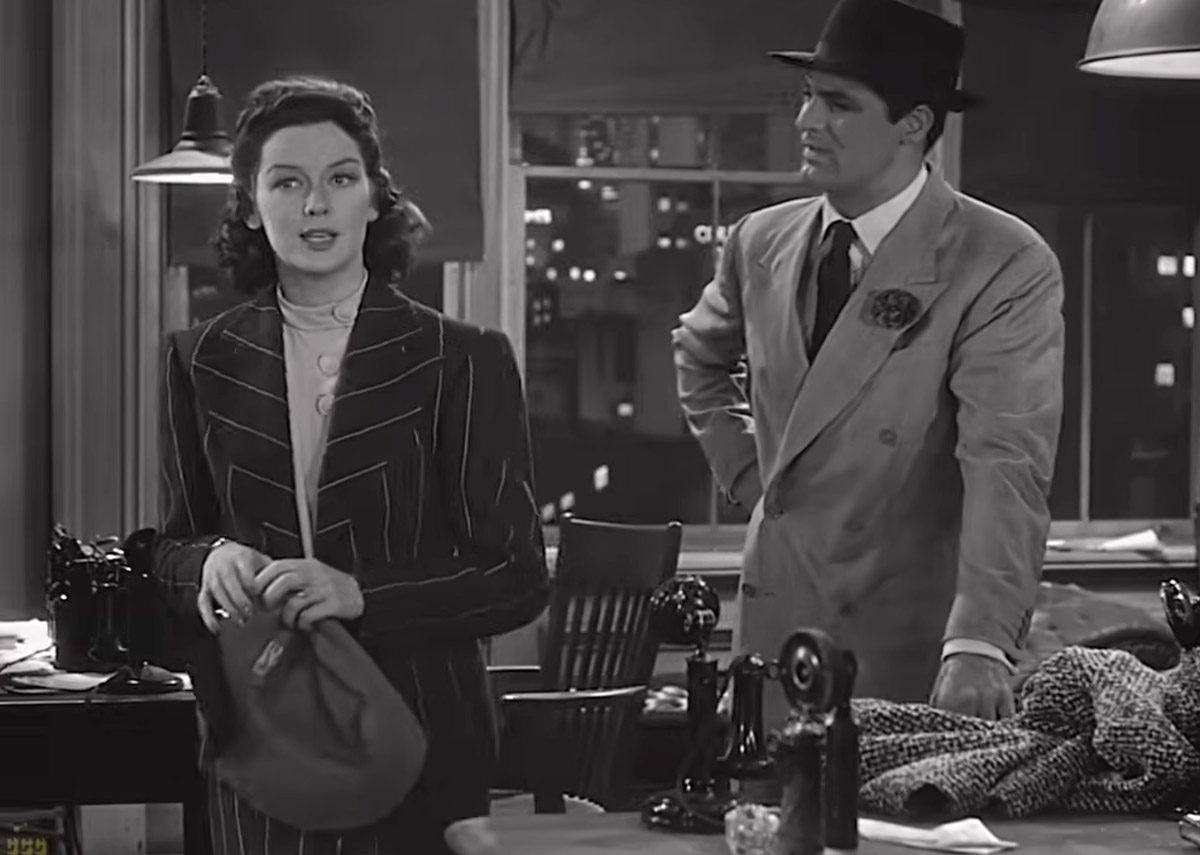
His Girl Friday, The Art of Howard Hawks
In 1940, Howard Hawks directed His Girl Friday, one of the finest examples of American screwball comedy. Beneath its humour lies an intelligent examination of journalism, ambition, human relationships and the power of words.
Hildy Johnson is an exceptionally talented reporter who wants to abandon journalism and begin a quieter life. Her former husband and editor, Walter Burns, is determined to prevent her from leaving the newspaper. What follows is not simply a romantic comedy, but a struggle between two powerful personalities who understand each other perhaps better than they understand themselves.
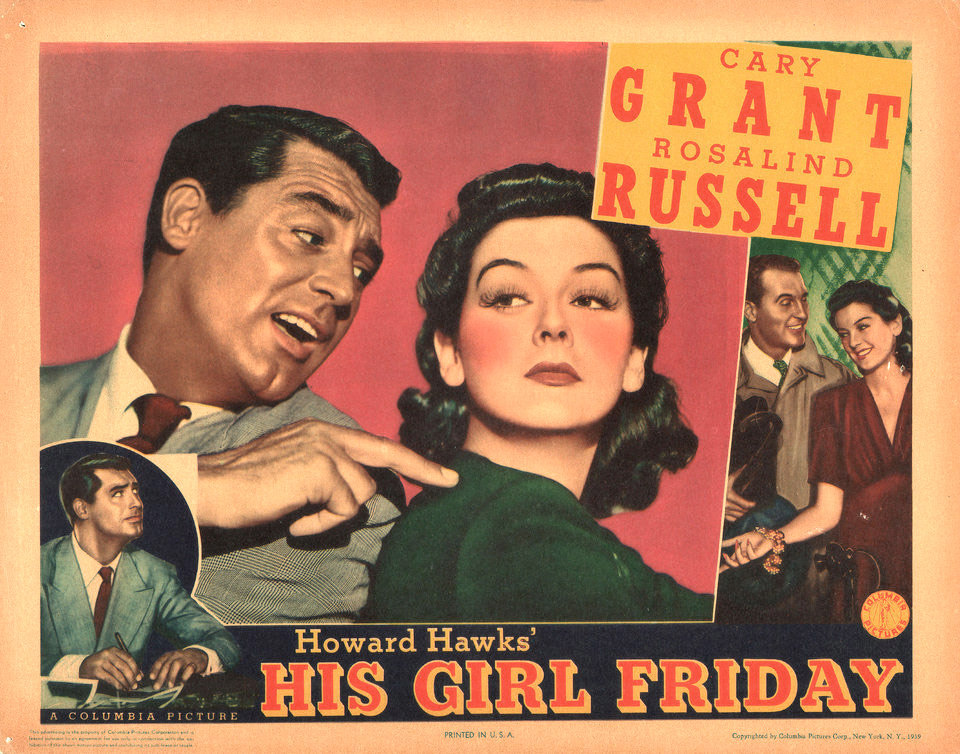
One of the film’s most extraordinary achievements is its use of dialogue. The characters speak at astonishing speed, interrupting one another, finishing each other’s sentences and often talking simultaneously. Hawks wanted to capture the energy of intelligent, impatient people working under pressure. Language creates its own rhythm, almost like a piece of music.
The visual direction is less noticeable but equally important. Hawks allows his actors to dominate the screen, while the crowded newspaper office becomes a carefully organised space where several conversations and actions can happen at once. This balance between chaos and control is one of his great achievements.
The performances are essential. Cary Grant brings elegance, charm and cruelty to Walter Burns, while Rosalind Russell gives Hildy intelligence, confidence and emotional complexity. Their relationship is based less on romantic declarations than on competition.
Hildy is particularly interesting in the context of Hollywood in the 1940s. She has a profession, a reputation and an identity of her own. Her greatest difficulty is deciding whether she can abandon a world in which she feels truly alive.
Yet the film is not entirely comfortable from a modern point of view. Walter’s behaviour raises difficult questions about love, control and personal freedom. The film invites us to admire his intelligence while also recognising how easily charm can become manipulation.
Beneath the comedy is a darker story about a condemned man, political corruption and the way human suffering becomes material for sensational headlines. The journalists who expose corruption are often dishonest themselves, creating a tension between comedy and cruelty.
His Girl Friday is not merely a comedy about journalists who talk too much. It is a film about people who are unable to escape the work they love, the lives they have created and, perhaps most importantly, each other.
From Stage to Screen
His Girl Friday was adapted from The Front Page, a successful stage play written by Ben Hecht and Charles MacArthur in 1928.
In the original play, Hildy Johnson was a man. The story focused on the relationship between a newspaper editor and his most talented reporter.
Howard Hawks made a remarkable decision: he transformed Hildy into a woman and imagined that the two main characters had once been married. This change introduced a romantic conflict without removing the original story’s criticism of journalism and political corruption.
The casting of Rosalind Russell was equally important. Russell brought intelligence, authority and extraordinary comic timing to the role. She reportedly felt that Cary Grant had been given more opportunities for humour, so she hired an additional writer to improve some of her lines.
The film also required an unusual approach to dialogue. Rather than waiting politely for another character to finish speaking, the actors frequently interrupted each other. This created a rhythm that was unusually fast for Hollywood cinema.
The result was a film that transformed a successful theatrical comedy into something distinctly cinematic.
The Newsroom: A World of Men
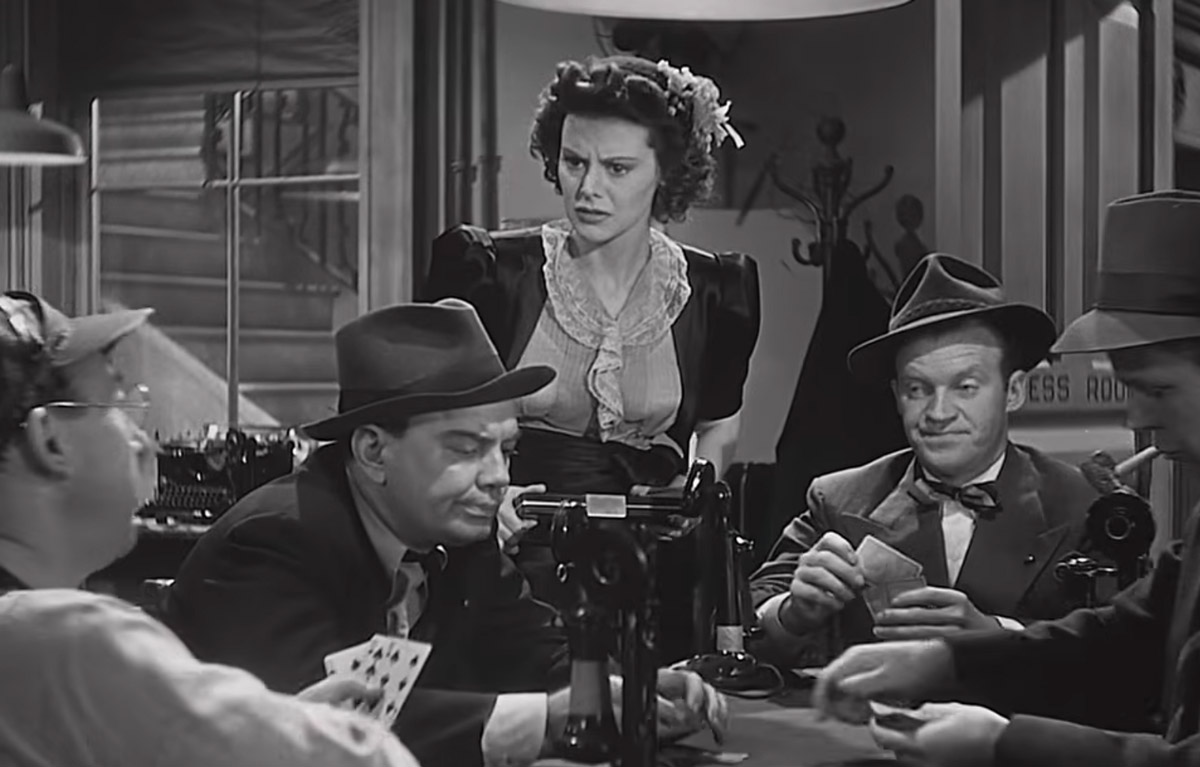
This image from His Girl Friday captures one of the film’s most important settings: the press room, where journalists spend their time waiting for news, exchanging information and competing for stories.
Howard Hawks carefully organises the composition. Hildy Johnson stands in the centre of the frame, surrounded by male reporters. While she appears concerned and attentive, the men remain seated, absorbed in their own activities.
The contrast is striking. Hildy is the only woman in the room, yet her position and expression make her the visual centre of the scene. She belongs to this masculine world, but she also stands apart from it.
Notice how Hawks uses the furniture, hanging lamps and overlapping figures to create a crowded atmosphere. The camera allows several characters to share the frame, giving the impression of a busy, realistic workplace.
There is also a darker meaning beneath the comedy. These journalists are covering a case involving a man’s possible execution, yet their everyday routines continue almost without interruption.
The image reflects one of the film’s central questions: what happens when human suffering becomes just another newspaper story?
With a seemingly ordinary scene, Hawks reveals an entire professional culture — competitive, energetic, entertaining and sometimes remarkably indifferent to human life.
Vocabulary
| Expression | Meaning / Example |
|---|---|
| Demanding | Requiring a lot of time, effort or attention: a demanding career. |
| To leave something behind | To move away from a situation or way of life: Hildy plans to leave her career behind. |
| To have no intention of + -ing | To be determined not to do something: Walter has no intention of losing Hildy. |
| To persuade someone to do something | To convince someone to act: Walter persuades Hildy to cover one final story. |
| Condemned prisoner | A prisoner who has been sentenced to death. |
| Exclusive story | A news story published by one newspaper before its competitors. |
| To abandon | To leave or give up something completely: Hildy wants to abandon journalism. |
| Beneath | Under something; also used figuratively: Beneath its humour lies a darker story. |
| Light-hearted | Cheerful and not intended to be serious. |
| Screwball comedy | A fast-moving comedy built around witty dialogue, misunderstandings and romantic conflict. |
| To finish each other’s sentences | To know someone so well that you can complete what they are saying. |
| To talk simultaneously | To speak at the same time. |
| To lose track of | To stop being able to follow or remember something: The viewer never loses track of the action. |
| To push aside | To ignore or give less importance to something: The search for truth is pushed aside. |
| To expose corruption | To reveal dishonest or illegal behaviour by people in power. |
| Relentless | Continuing without pause: relentless dialogue. |
| To be adapted from | To be made into a new form from an earlier work: The film was adapted from a play. |
| To stand apart from | To be different from, or separate from, others: Hildy belongs to the newsroom, but she stands apart from the men around her. |
Language in Action
The language of His Girl Friday is full of choices, pressure and influence. These structures help us describe what the characters do to one another.
Here is a short example of Walter’s persuasive style:
Walter: Why, divorce doesn’t mean anything nowadays, Hildy, just a few words mumbled over you by a judge.
Walter tries to make Hildy’s previous marriage sound easy to recover from. The line is charming, but it also shows how he uses words to pressure her.
Choosing one thing instead of another
Use rather than and instead of to show an alternative.
Hildy chooses journalism rather than a quiet life.
The actors interrupt each other instead of waiting politely.
After both expressions, we can use a noun or a verb ending in -ing.
Influencing another person
Some verbs describe how one character changes another character’s actions.
Walter persuades Hildy to cover one final story.
He prevents her from leaving the newspaper.
Notice the different patterns:
- persuade someone to do something
- prevent someone from doing something
Imagining a different decision
The second conditional helps us imagine an unreal or uncertain situation.
If Hildy stayed at the newspaper, she would probably remain successful.
If Walter were more honest, their relationship might be healthier.
We use:
if + past simple, would / might + infinitive
These structures are useful when we talk about difficult choices, alternative lives and the consequences of our decisions.
A conditional proposal
Walter tries to persuade Hildy to return to the newspaper. He presents remarriage as if it were a practical solution:
Walter: If we find we can’t get along in a friendly fashion, we’ll get married again.
Hildy: Oh, Walter, you’re wonderful in a loathsome sort of way.
Walter uses the first conditional to describe a possible future situation:
if + present simple, will + infinitive
Hildy’s reply is affectionate but insulting. Loathsome means extremely unpleasant or despicable. The humour comes from the contrast between Walter’s reasonable tone and Hildy’s sharp description of him.
An idiom about regret
When Walter explains why he did not want to let Hildy go, he uses an old proverb:
Walter: You never miss the water till the well runs dry.
The meaning is that people often fail to appreciate someone or something until it is no longer available. The sentence uses the present simple to express a general truth. In this scene, the proverb also reveals that Walter understands Hildy’s value only when he is about to lose her.