Family vocabulary
Learn useful vocabulary to talk about relatives, relationships, and different kinds of families.
1. Overview
2. Immediate family
| English | Spanish | Example |
|---|---|---|
| parent | padre o madre | Both of my parents are teachers. |
| mother / mum | madre / mamá | My mum works from home. |
| father / dad | padre / papá | Her dad loves cooking. |
| son | hijo | They have one son. |
| daughter | hija | Their daughter is at university. |
| child | hijo o hija / niño | They have one child. |
| children | hijos / niños | Their children are grown up. |
| brother | hermano | My brother is younger than me. |
| sister | hermana | His sister lives nearby. |
| sibling | hermano o hermana | I have two siblings. |
| husband | marido | Her husband is Canadian. |
| wife | esposa | His wife speaks Italian. |
| partner | pareja | I live with my partner. |
Child has an irregular plural: children, not childs. The word siblings is useful when we do not want to specify the gender of the brothers and sisters.
3. Extended family
| English | Spanish |
|---|---|
| grandparents | abuelos |
| grandmother / grandma | abuela |
| grandfather / grandad | abuelo |
| grandson | nieto |
| granddaughter | nieta |
| grandchild / grandchildren | nieto/a / nietos |
| aunt | tía |
| uncle | tío |
| cousin | primo o prima |
| nephew | sobrino |
| niece | sobrina |
In English, cousin is used for both primo and prima. Do not use cousin brother or cousin sister.
- Laura is my aunt. Her son Daniel is my cousin.
- My brother has a daughter, so I have a niece.
- My sister has two sons, so I have two nephews.
4. In-laws and blended families
Add -in-law to talk about our partner’s family or the partners of our siblings and children.
| English | Spanish |
|---|---|
| mother-in-law | suegra |
| father-in-law | suegro |
| parents-in-law | suegros |
| sister-in-law | cuñada |
| brother-in-law | cuñado |
| daughter-in-law | nuera |
| son-in-law | yerno |
Use step- to talk about a blended family:
- stepmother / stepfather — madrastra / padrastro
- stepsister / stepbrother — hermanastra / hermanastro
- stepdaughter / stepson — hijastra / hijastro
To show that two siblings share only one parent, use half-sister and half-brother.
- Ben is my stepbrother. Our parents are married, but we aren’t biologically related.
- Mia is my half-sister. We have the same mother but different fathers.
5. Marital status and family stages
| Expression | Meaning |
|---|---|
| be single | estar soltero/a |
| be in a relationship | estar en una relación |
| be engaged | estar prometido/a |
| get married | casarse |
| be married | estar casado/a |
| be separated | estar separado/a |
| be divorced | estar divorciado/a |
| be widowed | ser viudo/a |
| have a baby | tener un bebé |
| raise children | criar hijos |
Compare get married and be married:
- They got married in 2022. — They got married in 2022.
- They are married. — They are married.
To name the other person, use married to, not married with:
- Alex is married to Sam.
6. Describing family relationships
| Expression | Meaning |
|---|---|
| be close to someone | tener una relación cercana con alguien |
| get on well with someone | llevarse bien con alguien |
| look like someone | parecerse físicamente a alguien |
| take after someone | parecerse en carácter o comportamiento |
| grow up | crecer / criarse |
| bring up a child | criar a un niño |
| look after someone | cuidar de alguien |
| keep in touch | mantenerse en contacto |
| have an argument | tener una discusión |
| make up | reconciliarse |
- I get on well with my older sister.
- Leo looks like his father, but he takes after his mother.
- My grandparents brought up four children.
- We live in different countries, but we keep in touch.
Older and younger can be used to compare ages within a family:
- my older brother — mi hermano mayor
- my younger sister — mi hermana menor
- I’m the eldest of three children. — Soy el mayor de tres hermanos.
- She’s the youngest in the family. — Es la más pequeña de la familia.
7. Types of family
- immediate family — familia cercana: padres, hijos y hermanos
- extended family — familia extensa: abuelos, tíos, primos, etc.
- single-parent family — familia monoparental
- blended family — familia reconstituida
- only child — hijo o hija única
- twins — gemelos o mellizos
Avoid assuming that all families have the same structure. Parent, partner, sibling and relative are useful words for talking about people accurately without giving unnecessary information.
8. Common errors
- I have two childs. → I have two children.
- She is my cousin sister. → She is my cousin.
- I’m married with Daniel. → I’m married to Daniel.
- My fathers live nearby. → My parents live nearby.
- I have one brother and one sister. → You can also say: I have two siblings.
- He is my big brother. → To talk about age, it is more natural to say: He is my older brother.
9. Exercises
1. Can you find every member of the family?
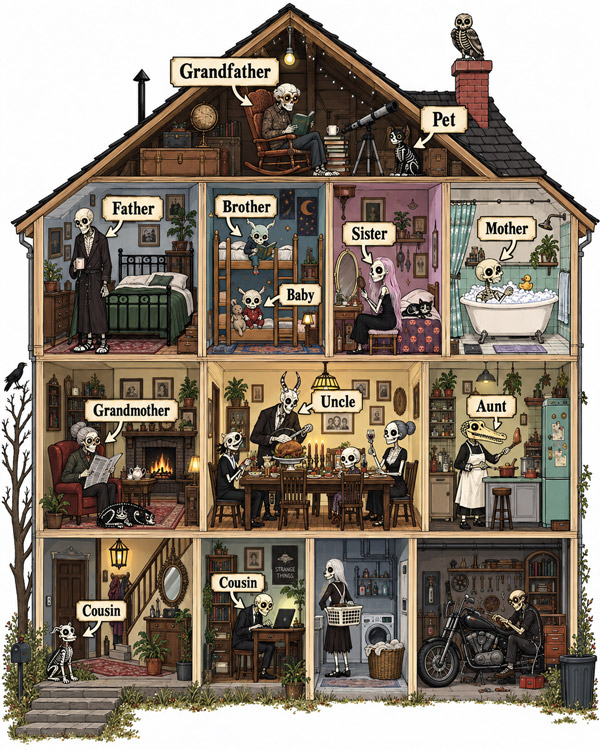
2. The troll family dinner
- Who is holding a metal mug?
- Who is laughing next to the grandfather?
- Who is cutting the roast?
- What is the mother doing?
- Who is pointing across the table?
- Which child looks bored?
- What is the little girl at the front doing?
- Who is sitting on a stool with a large piece of bread?
3. Complete the family tree
Read the relationships and write the missing word.
- My mother’s brother is my ______.
- My aunt’s daughter is my ______.
- My brother’s son is my ______.
- My son’s daughter is my ______.
- My father’s mother is my ______.
- My sister’s husband is my ______.
4. Choose the correct word
- My two childs / children are at school.
- Eva is my cousin / cousin sister.
- I have three parents / relatives in Australia.
- My wife’s father is my stepfather / father-in-law.
- We have the same father but different mothers, so Mia is my stepsister / half-sister.
- Tom has no brothers or sisters. He is an only child / alone child.
5. Match the two halves
Match each beginning with its ending.
| First part | Second part |
|---|---|
| 1. I look | A. in touch although we live far apart. |
| 2. My sister takes | B. after our grandmother. |
| 3. We get on | C. up in a small village. |
| 4. My cousins grew | D. like my mother. |
| 5. We keep | E. well with our stepfather. |
| 6. Our grandparents brought | F. up six children. |
6. Correct the error
- My sister is married with a French man.
- They have three childs.
- Paul is my cousin brother.
- My grandparents grown up in Ireland.
- I am very close with my aunt.
- My brother and I look us our dad.
7. Translate into English
- Tengo dos hermanos: una hermana mayor y un hermano menor.
- Me llevo muy bien con mis primos.
- Mi sobrina se parece físicamente a su madre.
- Mis abuelos nos cuidaban después del colegio.
- Laura está casada con mi hermano.