Moby Dick
Ahab, the sea and the obsessive search for the white whale.
The Story
In Moby Dick, Ishmael joins the crew of the whaling ship Pequod and sets out across the Atlantic and Pacific. The voyage is led by Captain Ahab, a powerful and mysterious man whose attention is fixed on one particular creature: Moby Dick, the great white whale.
As the ship travels through distant seas, the novel becomes a wide-ranging exploration of work, friendship, nature, knowledge and obsession. Melville combines adventure with humour, philosophy and some of the most distinctive prose in English literature.
Call Me Ishmael
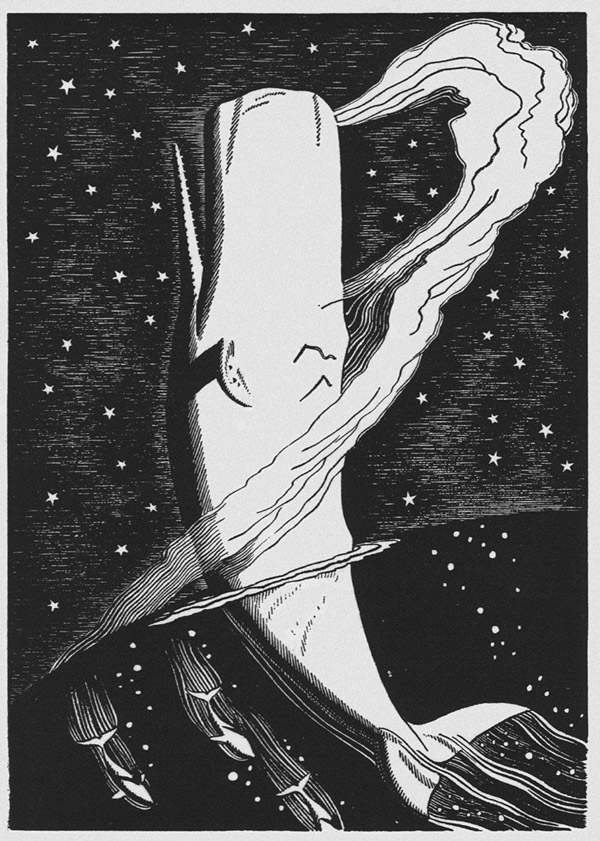
Call me Ishmael. Some years ago—never mind how long precisely—having little or no money in my purse, and nothing particular to interest me on shore, I thought I would sail about a little and see the watery part of the world. It is a way I have of driving off the spleen, and regulating the circulation. Whenever I find myself growing grim about the mouth; whenever it is a damp, drizzly November in my soul; whenever I find myself involuntarily pausing before coffin warehouses, and bringing up the rear of every funeral I meet; and especially whenever my hypos get such an upper hand of me, that it requires a strong moral principle to prevent me from deliberately stepping into the street, and methodically knocking people’s hats off—then, I account it high time to get to sea as soon as I can. This is my substitute for pistol and ball. With a philosophical flourish Cato throws himself upon his sword; I quietly take to the ship. There is nothing surprising in this. If they but knew it, almost all men in their degree, some time or other, cherish very nearly the same feelings towards the ocean with me.
There now is your insular city of the Manhattoes, belted round by wharves as Indian isles by coral reefs—commerce surrounds it with her surf. Right and left, the streets take you waterward. Its extreme down-town is the battery, where that noble mole is washed by waves, and cooled by breezes, which a few hours previous were out of sight of land. Look at the crowds of water-gazers there.
Circumambulate the city of a dreamy Sabbath afternoon. Go from Corlears Hook to Coenties Slip, and from thence, by Whitehall, northward. What do you see?—Posted like silent sentinels all around the town, stand thousands upon thousands of mortal men fixed in ocean reveries. Some leaning against the spiles; some seated upon the pier-heads; some looking over the bulwarks of ships from China; some high aloft in the rigging, as if striving to get a still better seaward peep. But these are all landsmen; of week days pent up in lath and plaster—tied to counters, nailed to benches, clinched to desks. How then is this? Are the green fields gone? What do they here?
Reading the Opening
The opening of Moby Dick does more than introduce a character. It teaches us how to listen to Ishmael’s voice. He begins by speaking directly to the reader: Call me Ishmael. The short sentence sounds simple and confident, but it also creates an immediate relationship between narrator and reader.
The repeated word whenever then gives the passage a strong rhythm. Ishmael lists several moments when he feels low, restless or trapped on land, making his mood feel like a pattern rather than a single bad day. The first paragraph also contains a very long sentence that moves from sadness, to irritation, to dark thoughts, and finally to the decision to go to sea. Its form reflects Ishmael’s restless mind: the sentence keeps travelling until it reaches the ocean.
Yet Ishmael does not describe his unhappiness in a completely solemn way. His image of knocking people’s hats off is comic and unexpected, allowing humour and melancholy to exist in the same voice. When reading a difficult literary passage, it helps to notice not only what the narrator says, but also how the language moves and what kind of relationship it creates with the reader.
Herman Melville, a Journey into the Unknown
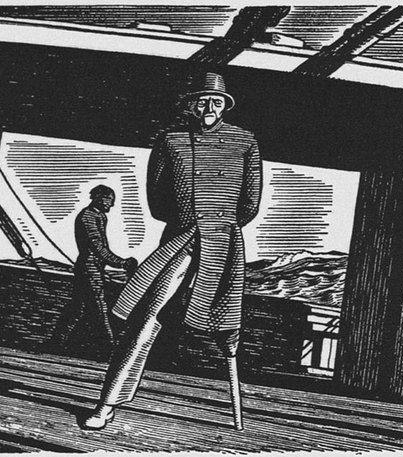
Before Moby Dick became one of the most celebrated novels in American literature, it was a difficult book to classify.
Its author, Herman Melville, knew the sea from experience. In 1841, at the age of twenty-one, he sailed from New Bedford aboard a whaling ship called the Acushnet. The voyage exposed him to the danger, exhausting work, and strange isolation of life at sea.
Ten years later, he published Moby Dick. At the centre of the story is Captain Ahab, who becomes obsessed with hunting an enormous white sperm whale. But the novel is far more than a sea adventure. It asks questions about fate, revenge, the power of nature, and the limits of human understanding.
The voice you have just heard belongs to Ishmael, the narrator. At the beginning of the book, he has little money, no clear purpose, and a troubled state of mind. He goes to sea because something in his life needs to change.
Notice how Melville combines humour with melancholy, and everyday observations with philosophical questions. In his hands, a voyage across the ocean becomes a journey into the human mind.
The book was not a commercial success in Melville’s lifetime. Its reputation grew long after his death, until it became recognised as one of the great achievements of American fiction.
Vocabulary from the Opening
| Word or expression | Meaning in context |
|---|---|
| Spleen | A feeling of sadness or irritability. |
| Hypos | Periods of low spirits or gloomy feelings. |
| Grim | Serious, gloomy or unpleasant. |
| Drizzly | Characterised by very light rain. |
| High time | The moment when something should already be done. |
| Wharves | Structures beside the water where ships load and unload. |
| Water-gazers | People standing and looking out at the water. |
| Circumambulate | To walk around something. |
| Reveries | Pleasant, thoughtful daydreams. |
Language in Action
Melville’s opening passage is also a rich example of how grammar can express habits, causes and imagined situations.
Describing repeated situations
Use whenever to mean “every time that”. Ishmael uses it to describe the feelings that repeatedly make him want to leave for the sea.
Whenever I find myself growing grim about the mouth, I want to get to sea.
Preventing an action
Use prevent someone from + -ing when something stops a person from doing an action.
A strong moral principle prevents me from stepping into the street.
Describing an imagined comparison
Use as if or as though to describe how something seems, even when it is not literally true.
The men stand by the water as if they were waiting for the sea to reveal something.
Saying that something should already happen
The expression it is high time to + infinitive means that something should happen now, or should already have happened.
I account it high time to get to sea as soon as I can.
These structures help Ishmael turn a personal mood into a pattern, a reason and finally a decision.