The Watchman of Skarvik
Follow a Viking watchman through a tense morning and practise reading, listening, and present-time language in context.
1. Overview
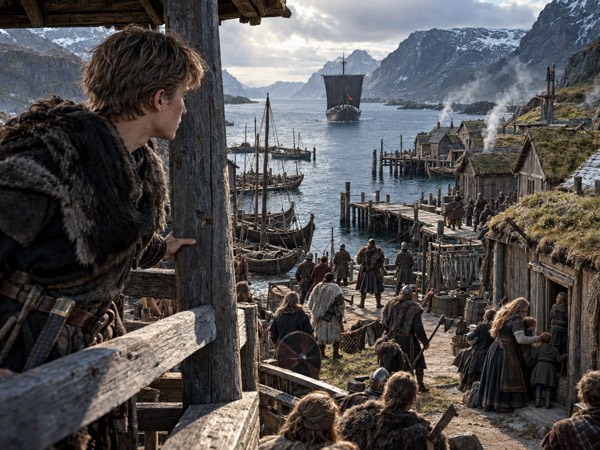
This story follows Einar, a young Viking watchman who sees a mysterious ship approaching his village. As the villagers prepare for danger, Einar must decide what he knows, what he believes, and what he can see from the tower.
The story combines reading and listening practice with language from the previous units: the present simple for routines, the present continuous for actions happening now, stative verbs, and adverbs of frequency.
First, listen to the story without reading the text. Then listen again while you read and complete the exercises.
2. Before you listen
Before listening, look at the image and think about these questions:
- What jobs do people have in a Viking village?
- Why is it important to watch the sea?
- What dangers can arrive from the coast?
3. The story
Listen first without looking at the transcript. Then listen again while you read.
4. First listening
Listen to the story once without looking at the text. Choose the best summary.
- Einar is preparing to leave Norway on a trading voyage.
- Einar sees an unknown ship approaching his village and believes it may be dangerous.
- Einar discovers that his father is secretly working with a trader.
- Einar is learning how to build Viking ships.
5. Second listening
Listen again and choose the correct answer.
- How old is Einar? (Fifteen / Seventeen / Nineteen)
- Where does Einar work? (On a fishing boat / In a blacksmith’s workshop / In a watchtower)
- What does Einar normally do from the tower? (He watches the sea. / He trains soldiers. / He repairs ships.)
- Why does the approaching ship worry the villagers? (It is damaged. / Nobody recognises it at first. / It has no sail.)
- What are some villagers doing when the ship approaches? (They are hiding their food. / They are carrying axes and shields. / They are leaving in fishing boats.)
- Why doesn’t Einar go down to help his father? (He is afraid. / His father tells him not to. / The guard tells him to stay in the tower.)
- What helps Einar recognise the ship? (A red cloth / A painted shield / A white bird)
- Who owns the ship? (Gunnar / Hakon / Einar’s father)
6. True or false?
Decide whether each statement is true or false according to the story.
- Einar often travels across the sea.
- He knows the boats that belong to the people in the village.
- The strange ship has a dark sail.
- Visitors normally arrive in Skarvik without warning.
- Einar’s father is near the harbour.
- Einar immediately recognises Hakon’s ship.
- Hakon has visited Skarvik before.
- The villagers attack the ship when it arrives.
7. Language in the story
The story contrasts routines with actions that are happening at that moment.
Present simple
It is used for routines, habits and usual facts:
- Einar lives in Skarvik.
- He usually arrives before sunrise.
- He watches the sea.
- Visitors sometimes come to Skarvik.
Present continuous
It is used for actions that are happening as the story unfolds:
- The ship is getting closer.
- People are gathering near the harbour.
- Some are carrying axes and shields.
- The man is waving.
Stative verbs
Some verbs describe states, thoughts or knowledge and normally appear in the Present Simple:
- Einar knows every boat in the village.
- Einar wants to go down and join his father.
- He remembers Hakon’s ship.
- He thinks the guard is right.
- Einar usually ______ before sunrise. (arrives / is arriving)
- Today a strange ship ______ towards the village. (comes / is coming)
- Einar normally ______ the sea from the tower. (watches / is watching)
- People ______ near the harbour now. (gather / are gathering)
- Some villagers ______ axes and shields. (carry / are carrying)
- Einar ______ every boat in the village. (knows / is knowing)
- He ______ to go down and join his father. (wants / is wanting)
8. Adverbs of frequency in context
In the story, adverbs of frequency show how often routines or events happen.
-
usually — usually
-
often — often
-
sometimes — sometimes
-
rarely — rarely / not often
-
always — always
-
Einar usually arrives before sunrise.
-
Visitors sometimes come to Skarvik.
-
They rarely approach without sending a message.
-
Hakon always ties a red cloth to his ship.
- Einar ______ arrives before sunrise. (always / usually / rarely)
- Traders ______ visit Skarvik. (sometimes / never / always)
- Visitors ______ arrive without warning. (usually / rarely / always)
- Hakon ______ puts a red cloth on his ship. (rarely / sometimes / always)
9. Think about the story
Answer in your own words. Different answers are acceptable if they are supported by the story.
- Why is Einar’s job important even though he usually finds it boring?
- Why do the villagers prepare for a possible fight?
- Why does the red cloth matter?
- What would probably happen if Einar didn’t recognise Hakon’s ship?
- Why does Einar feel differently about his job at the end?
10. Your turn
Imagine that you are Einar. Write or describe the moment when you see the ship for the first time.
Include:
- what you normally see from the tower;
- what you are doing when the ship appears;
- what the villagers are doing;
- what you think the ship is;
- how you recognise Hakon;
- how you feel at the end.
Try to use:
- at least two examples of present simple;
- at least two examples of present continuous;
- one stative verb;
- two adverbs of frequency.
Example beginning
I usually spend quiet mornings in the watchtower. I often watch the fishing boats leave the harbour. But today something is different. A large ship is coming towards Skarvik…