Quantifiers
Use common quantifiers with countable and uncountable nouns to talk about quantities, amounts, and enough or too much of something.
1. Overview
2. Countable and uncountable nouns
Before choosing a quantifier, decide whether the noun is countable or uncountable.
- Countable nouns can be counted and have singular and plural forms: one apple, two apples; one chair, three chairs.
- Uncountable nouns describe a substance, an idea, or a general amount. They don’t normally have a plural form: water, rice, money, information, advice, time.
| Countable | Uncountable |
|---|---|
| book, student, egg, bottle | water, rice, money, milk |
| There are three eggs. | There’s some rice. |
| How many bottles? | How much milk? |
Don’t use many with an uncountable noun or much with a plural countable noun. Say many books and much information, not many information or much books.
3. Some and any
Some is common in affirmative sentences with plural countable nouns and uncountable nouns:
- There are some apples in the fridge.
- We need some information.
Any is common in negative sentences and most questions:
- There aren’t any apples.
- We don’t have any information.
- Are there any seats left?
In offers and requests, some is natural when an answer of “yes” is expected or welcome: Would you like some coffee? and Could I have some water, please?
4. Much, many and a lot of
Use many with plural countable nouns and much with uncountable nouns:
- How many people are coming?
- How much money do you need?
- There aren’t many buses at night.
- There isn’t much time left.
Much and many are especially common in questions and negative sentences. In affirmative sentences, a lot of is often more natural in everyday English: I have a lot of work.
A lot of works with both types of noun: a lot of friends (countable) and a lot of work (uncountable).
5. A few and a little
Use a few with plural countable nouns and a little with uncountable nouns. They mean a small quantity, but usually a sufficient or positive quantity:
- I have a few questions.
- There are a few seats available.
- We have a little time before the film.
- Add a little salt, please.
Compare: I have a few friends (= some friends) and I have few friends (= not many). Also compare There’s a little coffee left (= enough for a small cup) and There’s little coffee left (= almost none).
6. Enough, too much and too many
Use enough to say that there’s the necessary quantity. It comes before a noun: We have enough chairs for everyone and Do you have enough money?
Use too much with an uncountable noun and too many with a plural countable noun. They mean more than is necessary or desirable:
- There’s too much sugar in this coffee.
- There are too many cars in the city centre.
| Meaning | Countable plural | Uncountable |
|---|---|---|
| necessary quantity | enough chairs | enough space |
| more than necessary | too many chairs | too much noise |
7. Common mistakes
- How much people are there? How many people are there?
- I don’t have many money. I don’t have much money.
- There is a few apples. There are a few apples.
- We need an advice. We need some advice.
- There are too much cars. There are too many cars.
- I have a little books. I have a few books.
Remember that advice, information, money, furniture and news are uncountable in English. Use some advice, a piece of information and a lot of money.
8. Exercises
1. Choose the correct quantifier
- There are much / many students in the library.
- We don’t have some / any bread.
- Would you like some / any tea?
- How much / many information do you need?
- She has a few / a little close friends.
- There’s a few / a little milk in the fridge.
2. Complete the sentences
Complete each sentence with a lot of, enough, too much or too many.
- There are ______ cars on this road. It’s always busy.
- We have ______ food for everybody.
- He drinks ______ coffee and can’t sleep.
- They have ______ homework this weekend.
- There are ______ people in the room, so let’s find a bigger one.
3. Correct the mistakes
Each sentence has one quantifier mistake. Write it correctly.
- How much eggs do we need?
- There isn’t many water in the bottle.
- I have a little questions about the exercise.
- She gave me an advice about the job.
- There are too much people here.
- We don’t have some clean glasses.
4. Complete the dialogue
Complete the dialogue with some, any, much, many, a few or a little.
- A: Do we have ______ tomatoes? B: Yes, we have ______ in the fridge.
- A: How ______ rice do we need? B: Just ______, about two cups.
- A: Are there ______ clean plates? B: Yes, there are ______ in the cupboard.
- A: How ______ guests are coming? B: There aren’t ______; only six.
5. Personal practice
Answer the questions with complete sentences. Use at least one quantifier in each answer.
- How much free time do you have today?
- How many people are in your family?
- What food do you have a lot of at home?
- What do you have too much of sometimes?
6. The Last Supplies
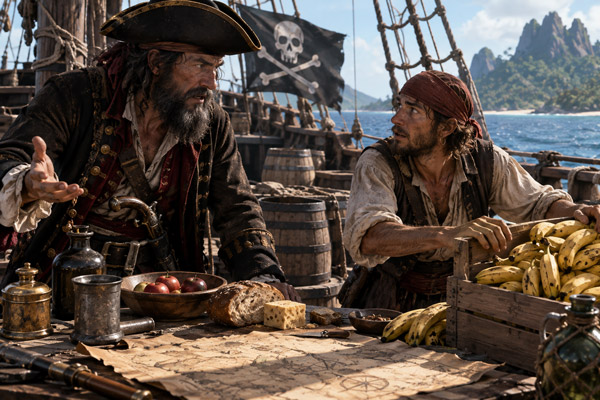
Captain Flint and Barnaby are pirates sailing across the Caribbean. Their journey hasn’t gone exactly as planned, and their ship is running out of supplies.
Read their conversation and find out what they have left, what they need, and why Captain Flint isn’t very happy with Barnaby.
As you read, pay attention to the quantifiers they use to talk about different amounts and quantities.
Captain Flint: How much food do we have left?
Barnaby: Not much, Captain. We have a little bread, some cheese, and a few apples.
Captain Flint: That’s all?
Barnaby: I’m afraid so. We had a lot of food when we left Port Royal, but the crew has been eating too much.
Captain Flint: Too much? There are only twelve men on this ship!
Barnaby: Twelve very hungry men. And we have another problem.
Captain Flint: Of course we do. What is it?
Barnaby: We don’t have much fresh water left.
Captain Flint: How many barrels do we have?
Barnaby: Two.
Captain Flint: Two barrels? That isn’t enough water to reach Jamaica.
Barnaby: I know. But we still have a lot of rum.
Captain Flint: Rum isn’t water, Barnaby.
Barnaby: The crew may disagree.
Captain Flint: What about cannonballs? Do we have enough?
Barnaby: More than enough. We have too many cannonballs and not enough food. We could probably sink the entire Spanish fleet, but we can’t make breakfast.
Captain Flint: Excellent planning.
Barnaby: Thank you, Captain.
Captain Flint: That wasn’t a compliment.
Barnaby: Ah.
Captain Flint: Is there any fruit apart from those apples?
Barnaby: There’s some fruit in a wooden box in your cabin.
Captain Flint: My cabin? I don’t have any fruit in my cabin.
Barnaby: You do now.
Captain Flint: What’s in the box?
Barnaby: A lot of bananas.
Captain Flint: How many?
Barnaby: About forty.
Captain Flint: Forty bananas? Why do we have so many bananas?
Barnaby: I bought them from a merchant yesterday.
Captain Flint: We needed water!
Barnaby: He didn’t have any water.
Captain Flint: So you bought forty bananas?
Barnaby: They were very cheap.
Captain Flint: Barnaby, sometimes I think you have too much enthusiasm and too little common sense.
Barnaby: Perhaps. But we have enough bananas.
Captain Flint: Get the map. We need to find an island before the water runs out.
Barnaby: There are a few small islands north of here.
Captain Flint: Are there any villages?
Barnaby: There’s one village on Black Crab Island. It has a small harbour and a lot of fishermen.
Captain Flint: Good. They should have some fresh water and enough food for the crew.
Barnaby: And perhaps they need some bananas.
Captain Flint: Barnaby…
Barnaby: Yes, Captain?
Captain Flint: Get the map.
- The pirates have only ______ bread left.
- They don’t have ______ fresh water.
- They have ______ cannonballs. They don’t need all of them.
- Barnaby bought ______ bananas.
- There are ______ small islands north of the ship.
- The merchant didn’t have ______ water.
- Captain Flint hopes the village has ______ food for the crew.
- The crew has been eating ______.